ONE Council District for Downtown Pasadena

Downtown Residents Demand to be Better Represented.

A letter to Pasadena’s City Council and the Redistricting Task Force.

To:  Mayor Bill Bogaard, Pasadena City Council: Jackie Robinson, Margaret McAustin, Chris Holden, Gene Masuda, Victor Gordo, Steve Madison, Terry Tornek, and members of the Redistricting Task Force:

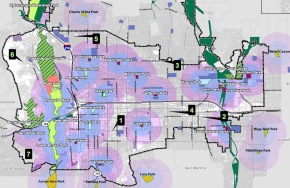
The Downtown Pasadena Neighborhood Association opposes the current City Council District Boundaries, and the proposed revisions adopted by the Redistricting Task Force. Downtown Pasadena is currently split up between 4 different council districts, an arrangement that is harmful to both Downtown residents and Downtown businesses, who have unique characteristics and interests that are underserved by the four-way split. The proposed revisions by the Redistricting Task Force do not correct this split.

What makes life in Downtown Pasadena different? There are several factors that define people who choose to live in mixed-use town-centers versus those who prefer to live in exclusively residential centers and be transported to commercial and cultural centers. The following factors are welcomed as defined values that improve quality of life as follows:

1. Integration of Commercial and Residential Activities: Business and economic activity is integrated into the fabric of the neighborhood in such a way that residents comfortably interact, and develop human-scale relationships with local commercial enterprises. People who live in mixed-use town-centers form a base that is beneficial to the local economy. Commercial establishments see the local population as a ‘captured audience’, who, given their disassociation with car-dependency, becomes a shared welcome between both entities. But the benefits of relationships do not end on the level of commercial/economic exchange. This concept of a ‘captured audience’ moves beyond the status of commercial-retail to one capable of attracting quality employers.

2. Diversity of Social and Economic Status: Social interaction is not limited amongst the elderly, dog- walkers, families, students, homeless, shoppers and office workers (to name a few). Such interactions whether planned or spontaneous, are definitely diverse across socio-economic levels, race and ethnicity, age and family types.

3. Safety in Numbers: Diversity of people creates the opportunity where the urban fabric is occupied throughout many hours of the day. During the early morning and late afternoon, families and the elderly are typical pedestrians, while during the daytime, commercial workers travel the streets. Evenings, including late nights, bring out the greatest diversity of individuals, including many from the suburbs. Therefore, it is active social activities (rather than reactive helicopter police security) that create ongoing public safety.

4. Facile Access to Cultural Activities: The most unique experiential effect of mixed-use town center living occurs for those residents whose fullest sense of ‘home ownership’ extends beyond the front door and into the community: For example, arts and cultural interactions are more often experienced beyond the ‘living room’. These cultural activities can be experienced as isolated and contemplative moments, or amongst groups as interactive social events. The importance of the experiential effect is that it has the added enrichment of unplanned spontaneity at public spaces such as museums, parks, and even streets, and can be free or require admission.

5. Efficient Use of Time: People who move into a mixed-use town-center typically trade-in the time associated with automobile usage to discover the freedoms of a ‘walkable lifestyle’. With everything from shopping, entertainment, work, and education within a 10-20 minute walk, even families with children benefit from an increase in shared activities.

6. Special Requirements to the Built Environment: Many of the ‘quality of life’ items listed above fall outside the domain of the city administration and its politics and under direct control of its citizenry. However, the following items are a very direct consequence of political influence, and therefore, the following changes are requested, not just to improve the quality of life within the Central District, but to keep it competitive with other cities that have learned to copy Pasadena’s renaissance of the 1990′s.

  1. Multi-modal Transportation – Downtown residents are not car dependent, and view walking and cycling as the primary alternative modes of transportation within Downtown Pasadena. Public policy must be changed so that analysis and decision-making are no longer made through the lens of auto-superiority. With a strong residential core it must no longer be assumed that people will traverse and/or arrive in Downtown Pasadena via an automobile and require a parking spot. Instead, resources should be directed towards improving the pedestrian/cycling experience: Sidewalks and bike paths should be busier than our streets.
  2. Parks – Downtown Pasadena has a shortage of parks. Ironically, this is in spite of the fact that Downtown residents have a greater need for parks and green public space, since mixed-use/multi-family housing typically lacks private green space. While Park Funds have been collected from new construction within the Central District, these monies have gone to fund parks outside the District: In essence, residential buyers in the Central District pay a premium through Park Funds for the purchase of their units, but require automobiles to access them outside the district. In the meantime, it does not seem correct that existing parks such as the ‘Central Park’ languish from maintenance, security and a diversity of uses to accommodate a diverse population, or that the creation of new parks also remains ignored.
  3. Construction Defects – Given the extent and pervasive nature of construction defects of buildings within the Central District [new buildings that leak, have cracked foundations, etc due to faulty construction], it is obvious that related building and permitting departments have not kept abreast of the constant evolution and complexity of building systems within mixed-use buildings. The cost and lifestyle inconveniences associated with the construction defects of these building types makes it clear that all associated city departments must re-strategize how best to mitigate these persistent problems, in such a way to keep new property owners welcomed. Also, given that buildings, both during their construction phase and throughout their life, present the greatest environmental impact, the City Administration should begin to put into place a plan that also mitigates these impacts (for example LEED Certification should be considered within the overall strategy of Cap and Trade) to create dense and energy efficient buildings.

Downtown Pasadena residents, therefore, have unique interests and a different lifestyle that deserves appropriate recognition and representation on Pasadena’s City Council.

Downtown Pasadena Residents feel underserved or ignored, as demonstrated by bias in official city documents (i.e. Guiding Principle #1, which insinuates that Downtown Pasadena is not a neighborhood and that the city belongs [the word "our"] only to residents who live outside of Downtown Pasadena), and by the actions of City Council members, including the failure to proportionately appoint Downtown residents to commissions and advisory boards, “kitchen cabinets” etc., and by policy decisions, communications, and general inattentiveness.

The four-way split must be eliminated. Downtown Pasadena must be represented by a single council district. Such an arrangement will improve the representation of Downtown Pasadena on the City Council.

Therefore, the Downtown Pasadena Neighborhood Association urges adoption of the following “One Downtown” district map:

Sincerely yours,
Downtown Pasadena Neighborhood Association

Endnote: Guiding Principle #1, the wording of which displays a bias against Downtown Pasadena as its own distinct neighborhood: “Growth will be targeted to serve community needs and… will be redirected away from our neighborhoods and into our downtown.”

DPNA’s Third-Thursday Monthly Meeting:

This month’s meeting will be a relaxed social affair, and a chance to debrief. Our normal location is the Gamble Lounge at Pasadena Presbyterian Church, but this Thursday we will meet for dinner at the private room at Abricott, a lovely new restaurant at 238 S. Lake.  Call 626-539-3762 or email DPNAlist@gmail.com for details.

Posted in council districts, elections, Pasadena City Council District 3, Pasadena City Council District 5, Pasadena City Council District 6, Pasadena City Council District 7, redistricting, walkability, Why We Love Pasadena | Tagged , , | Leave a comment

Jan 19th Meeting will coordinate ACTION on Pasadena’s General Plan

Political Winds are shifting in the City of Roses

Despite the holidays, December was a very active and productive month for the DPNA, and we’ve hit the ground running in 2012. The executive team has an exciting meeting planned for Thursday, January 19 that will bring members up to speed on all our progress, and create an ACTION PLAN for the month of February and beyond.

We are expecting quite a few new members  at the meeting, and encourage everyone to actively mention the DPNA to your neighbors, homeowners associations, and friends, and invite them to come to the meeting.

Details:

Thursday, January 19 at 6:30 PM

Pasadena Presbyterian Church, the Gamble Room (the central parlor that faces the courtyard between the older education wing and the new auditorium) Corner of Madison & Colorado.

585 E Colorado Blvd, Pasadena CA 91101

For questions, call 626-539-3762 or email DPNAlist@gmail.com

See you there!

Posted in Agendas & Action Items, Pasadena General Plan | Tagged | Leave a comment

New York Times calls Pasadena a “Transforming Suburb”

Demographic Trends Make Walkable Urban Neighborhoods More Desirable

Pasadena real estate will continue to hold value if the city continues support for higher-density mixed-use developments with good transit and pedestrian connections.

A recent op-ed piece in the New York Times by Christopher B. Leinberger explains why Pasadena housing values have not suffered as greatly as “fringe suburbs” (the drive-till-you-qualify tract home suburbs in the Inland Empire and outer LA county):  Pasadena’s density and walkability is increasingly more desirable.

In the late 1990s, high-end outer suburbs contained most of the expensive housing in the United States, as measured by price per square foot . . . Today, the most expensive housing is in the high-density, pedestrian-friendly neighborhoods of the center city and inner suburbs.

. . . Simply put, there has been a profound structural shift — a reversal of what took place in the 1950s, when drivable suburbs boomed and flourished as center cities emptied and withered.

This increased demand for high-density, pedestrian-friendly neighborhoods is the result of a demographic shift in 2 generations, he explains:

1. The Baby Boomers–who are gradually becoming empty-nesters–are downsizing from larger homes.

2. The Millennials–who are just starting to leave the nest–have been raised on sitcoms in urban settings (Seinfeld, Friends, Sex in the City vs. the Boomers’ Leave it to Beaver, The Brady Bunch, etc.) and therefore consider city life to be an attractive norm. Also, Millennials are marrying and producing children at lower rates than previous generations, and need less space for smaller households.

Pasadena, as an inner suburb of Los Angeles with its’ own urban core, has enhanced its’ walkability and therefore desirability by permitting higher-density mixed-use development in Downtown Pasadena, replacing single-story strip malls with multi-story condos/apartments that have retail or commercial uses on the ground floor.  By placing these developments next to the Gold Line, and by making the Downtown Neighborhood more pedestrian-friendly, a Downtown resident is less dependent upon a car to fulfill daily needs.  That’s an increasingly attractive option that is in short supply nationwide.

Pasadena should support this trend with a General Plan that allows greater density within the Downtown’s Central District, a General Plan that does not stifle development with severe height restrictions but rather encourages function and design that engages pedestrians. Keeping in mind that Pasadena’s allure also is due to its many beautiful older building and historic character, Pasadena should demand that new development be equally high-quality and/or respectful of historic landmarks. And, Pasadena should invest in more pedestrian-friendly improvements, such as a streetcar system that would extend the walking range of residents and make parking easier for visitors.

Read the New York Times article here: The Death of the Fringe Suburb, November 25, 2011 by Christopher B. Leinberger

For a much more in-depth analysis, see: The Next Real Estate Boom, The Brookings Institution, November 2010.

Posted in Demographics, Pasadena General Plan, Placemaking, Real Estate Values, walkability | Tagged , , , , , , , , , , , , , , , , , , , , , , , , , , , , , , | Leave a comment

Dec 6th Holiday Meeting of the DPNA

The Downtown Pasadena Neighborhood Association will be meeting on Tuesday, December 6, 2011 from 6:30 to 8:00 p.m.

Please join us!

We will be enjoying a little holiday cheer and also discussing strategies for the coming year.

Most importantly, we plan to set a regular reoccurring meeting schedule (such as 2nd Tuesday of each month, 3rd Monday, etc). If you cannot make the Dec 6th meeting, please email DPNAlist@gmail.com with suggestions and known conflicts.

Other items for possible discussion may include:
- General Plan strategy, in light of the recent presentation by Christopher Leinberger.
- Political Strategy – Encouraging proactive leadership among current council members and future candidates.
- Streetcar in Downtown Pasadena.
- Marketing a focus on the economic impacts of the General Plan.
- Monitoring city planning & other goings-on.

The meeting will be at Pat R.’s home in Old Pasadena. Please RSVP to DPNAlist@gmail.com in order to obtain the exact address.

Hope to see you all there.

20111124-140400.jpg

Posted in events | 1 Comment

Leading Urbanist to Present Talk about “The Future of Placemaking in Economic Development …and How This Has Particular Meaning for Downtown Pasadena”

The Playhouse & Old Pasadena Management Associations will present a very special discussion with Christopher Leinberger. He will present “The Future of Placemaking in Economic Development …and How This Has Particular Meaning for Downtown Pasadena at 2:00pm on Tuesday, October 25, 2011. Event Details 

For more about Placemaking: Project for Public Spaces

About Christopher B. Leinberger:

A leading thinker in Urban Planning. Visiting Fellow at Brookings Institute; Noted author; and Voted one of the “Top 100 Urban Thinkers”.
From his website:

The building of the built environment (real estate and the infrastructure that supports real estate) is in the middle of a structural change.

The previous mid-20th century structural change converted real estate development into a modular, formula-driven industry, based upon access and parking of automobiles and trucks; I refer to it as “drivable sub-urbanism”.

The real estate industry responded to the market demand of the day and yielded many benefits. Yet we now know that it actually narrowed consumer options, consumed land at 6-8 times population growth and produced “could be anywhere” places, based upon the “19 standard product types”. These drivable sub-urban formulas are re-enforced by the financing of much of commercial real estate which has turned what for thousands of years was a 40-year asset class into a product with a 7-10 year life.

There are many unintended social, economic, health and environmental consequences resulting from how America has been developing its built environment over the past two generations. These consequences include, among others:

• dependency on a car/truck-only transportation system which is putting excessive financial pressure on household budgets
• social segregation and secession of elites,
• dependency of about 1/3rd of the population who do not drive,
• subsidized public and private infrastructure for drivable sub-urban development that is increasingly expensive to build and maintain,
• lack of unintentional daily exercise which has partially contributed to the obesity epidemic,
• indirect impact on American foreign policy which is skewed toward securing sources of foreign oil from countries increasingly hostile to the US,
• economic exposure to increasing oil prices as the potential of “peak oil” approaches and
• over 70% of greenhouse gas emissions and, therefore, the major contributor toward climate change.

Over the past 15 years, many consumers have been demanding different options to the “one-size-fits-all” drivable sub-urbanism. While single-family homes on large lots and strip commercial will be a significant part of the market demand for decades to come, there are many segments of the population that want something different; what I refer to as “walkable urbanism”. This is where most daily needs can be met within walking or rail transit distance. These alternatives include downtown and suburban downtown revitalization, New Urbanism, transit-oriented development, green field mixed-use development (“lifestyle centers”), regional mall redevelopment, among others.

Progressive public policy responses that allow for and promote this kind of development include smart growth, strategy and management of walkable urban places, impact fees that “level the planning field”, affordable & workforce housing development and creating “blueprint plans”, for the economic development and transportation future of metropolitan areas.

Posted in old pasadena, playhouse district, south lake avenue, events, Pasadena General Plan, Placemaking, economic development, competition for consumers | Tagged , , , , , , , , , , , , , , , , , , , , , , , , , , , , , , , , , | Leave a comment

Why We Love Pasadena: “Big City” Arts and Culture

Saturday night, Pasadena music lovers scowled in consternation as they studied their date books and were forced to make a choice between TWO excellent orchestras, both performing in central Pasadena at the same time: the Pasadena Symphony, and the Colburn School Orchestra.

The Pasadena Symphony performed a free special concert, “Music Under the Stars,” in front of City Hall. Featuring music from Broadway musicals, along with performances by other local musicians and choirs, and a family festival with food trucks providing the munchies, residents stretched out in their lawn chairs and enjoyed the music under the clear night sky.

The Robinson brothers also enjoyed "Music Under the Stars," performed by the Pasadena Symphony in front of City Hall. During the concert, the expression on their faces was much less stony! Er, iron-y! Hah!

A few blocks away, in the gorgeous and acoustically excellent Ambassador Auditorium, the orchestra of the Colburn School of Music opened its concert season with Mussorgsky’s much–loved “Pictures at an Exhibition.”

Pasadena's Ambassador Auditorium, home of HRock Church, the Pasadena Symphony, and the Colburn Orchestra

Although not as well-known as, for example, Julliard or the Eastman School of Music, Downtown Los Angeles’ Colburn School provides similar elite music instruction to competitive young musicians. This year, the Colburn School chose the Ambassador Auditorium as its preferred venue, and its orchestra will perform its entire season at the Ambassador.

A Full House: The orchestra of the Colburn School of Music performs inside the Ambassador Auditorium

Obviously, word has spread of these excellent free concerts, because on Saturday night all tickets were sold out, and the “rush” line of people hoping to snag a no–show seat was at least 50 people deep.

Those lucky enough to get in were well rewarded. The student musicians dug into their parts enthusiastically. I was especially struck by how rich and solid the string section sounded, playing together with perfect intonation and rhythm, the upper strings strongly supported by the lower strings.

Joseph Brown revealed a wonderful new timbre that I had never heard before in his trumpet solos, Christopher Bartz coaxed a magnificently blended orchestral sound out of his alto saxophone, and Francesca dePasquale, the soloist for Dvorak’s Violin Concerto, performed on the 1st part of the program, was virtuosic.

The point is, for a city of only 140,000 people, Pasadena enjoys an extraordinarily high number of artistic and cultural events, and it’s a reason that residents frequently cite when talking about why they love their city. Indeed, one of Pasadena’s Seven Guiding Principles is: “Pasadena will be promoted as a cultural, scientific, corporate, entertainment, and educational center for the region.”

If we consider orchestras alone, Pasadena is home to the following: the Pasadena Symphony, the Pasadena Pops, the Colburn School, Muse/ique, the Pasadena Community Orchestra, the Pasadena Young Musicians Orchestra, the Crown City Symphony, the Lake Avenue Chamber Orchestra, the Caltech–Occidental Symphony Orchestra, and the Southwest Chamber Music ensemble.

At an average of 50 musicians per orchestra, that’s 140,000 / (50×10) = 1 musician per 280 residents!

That’s a silly statistic, of course, but still impressive and kind of fun. Santa Monica and Long Beach would stack up similarly, I suspect. But Pasadena has the advantage of close proximity and reliably quick access to Downtown LA, the true cultural center of Southern California, via the Gold Line and its own effectively private freeway, the 110.

A number of factors contribute to Pasadena’s cultural richness, not the least of which is the socioeconomic makeup and educational attainment of its populace. But also important are population density* and community engagement*, which we often discuss on this blog.

As the arts are of interest to a minority of people, it takes a critical mass (quantity) of local (proximity) supporters to fund and attend events. Quantity ÷ Proximity = Density.

Community engagement is that ephemeral measurement of a people’s social attitudes towards one another, and the propensity of those people to act upon those feelings.  Do a city’s people care about what goes on in their city? Do they bother to get to know their neighbors? To be friendly? To join local causes? Show up to meetings? Drop by each others’ houses? Host parties? Participate in local sports? Volunteer at a church or school? Read the local newspaper? Smile at passers-by?  Vote?  Get involved with a neighborhood association? <ahem> 

Those are activities and habits that do not occur naturally on their own, in a vacuum, but which must be cultivated and maintained, and which depend on collective participation by everybody.  Pasadena has historically done well in this regard; we have been joiners and doers, and that’s why the arts are alive in Pasadena.

Let’s keep it that way!

* For further reading on the importance of density & efficiency in cities, I recommend Richard Florida’s article in the Atlantic Monthly: “The Rise of the Social City.”  On community engagement, the seminal work is Bowling Alone by Robert Putnam.

Posted in arts, events, Pasadena's Guiding Principles, social capital, Why We Love Pasadena | Tagged , , , , , , , , , , , , , , , , , , , , , , , , , , , , , , , , , , , , , , , | 1 Comment

Pasadena Redistricting – Four Districts for Downtown?

Downtown Pasadena is split into FOUR council districts.

Pasadena is geographically divided into seven districts, with one council member for each. The 2010 census forces Pasadena to re-draw the lines for each district.

The DPNA is interested in how Downtown Pasadena is represented.  Currently, our neighborhood is split into FOUR Districts. This raises a number of questions that will be worth considering in the months ahead:

  1. Do our elected representatives and city staff recognize Downtown Pasadena as a distinct neighborhood?
  2. Are there distinct sub-neighborhoods within Downtown Pasadena that would justify current or alternative boundary lines?
  3. If not, is there a compelling governmental interest that justifies splitting the Downtown Pasadena neighborhood?
  4. How does the distinction between residents of single-family dwellings vs. residents of  multi-family dwellings (apartments/condos) factor into the boundary lines? How should it?
  5. Are there relevant demographic and lifestyle characteristics of Downtown Residents that are substantially different from other Pasadena residents?  Do Downtown Residents, who live in high-density apartments and condos, have different values and needs compared to low-density suburban residents?
  6. If so, do the current boundaries unfairly dilute the voting power of Downtown Residents?

The current council appointed a special redistricting commission, who will meet twice a month, discuss, and then recommend new boundary lines for the City Council districts.  We hope the commission will consider and address the above questions. Join us as we attend the commission meetings and participate in conversation.

Access meeting schedules and more information at: www.cityofpasadena.net/cityclerk/redistricting

Downtown Pasadena--shown in red. Click the image to explore an interactive Google map

Posted in council districts, elections, Pasadena City Council District 3, Pasadena City Council District 5, Pasadena City Council District 6, Pasadena City Council District 7, redistricting | Leave a comment